ORP is strictly based on the spectral characteristics of the EEG, and its values reflect the well established pattern of paradoxical changes in power of slow and fast EEG frequencies as sleep gets deeper (1,2). ORP is also a continuous scale with no particular values that separate distinct levels of sleep depth. On the other hand, conventional staging of non-REM sleep divides sleep depth into distinct levels based on: a) features (spindles, K complexes, delta waves) that are not particularly related to sleep depth, and are highly variable among individuals (3), and b) arbitrary guidelines as to when sleep depth should change from one stage to the next (4).
Specifically:
a) The guidelines (4) specify that stage N2 should be changed to N1 if an arousal occurs, and should remain in N1 until a spindle or K complex appears. The frequency of arousals within stage N2 is highly variable among individuals (5), so the number of conversions to N1 is highly dependent on this variable arousal index. Furthermore, once a switch occurs, the time before it is switched back is highly dependent on spindle and K complex frequency. K complexes are very infrequent, so the time added to N1 is largely dependent on spindle frequency, which varies from 4 per minute (2 per epoch) to one every 4 minutes (6). It follows that for every arousal in stage 2, between 0 and 4 minutes are added to N1 time. In addition, there is no evidence that spindle frequency is positively related to sleep depth. In fact, the evidence is to the contrary (7). These guidelines, accordingly, result in little or much increase in N1 time at the expense of N2 time, due to interindividual differences in variables that are unrelated to sleep depth.
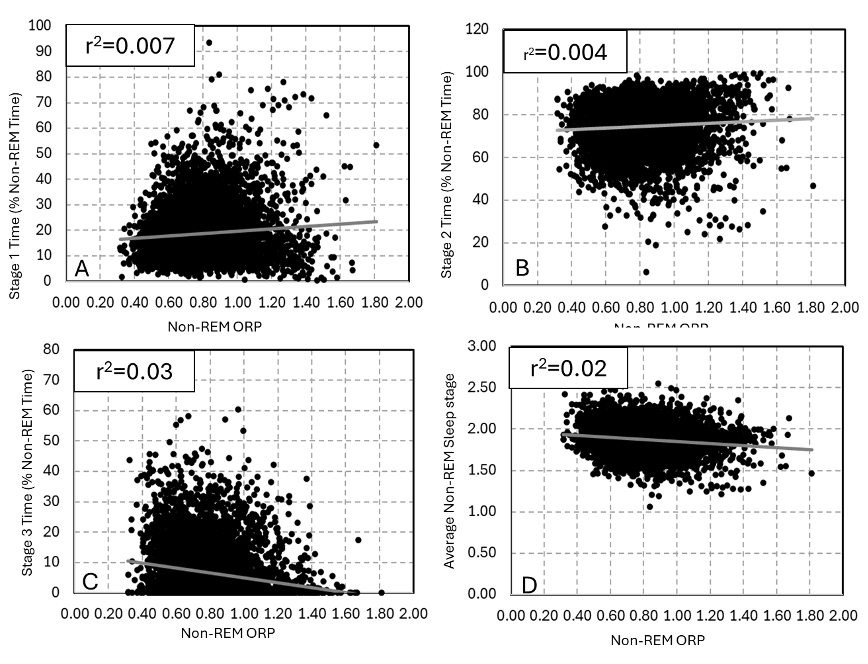
b) It is not clear why an increase in the total duration of delta waves in a 30-second epoch from <6 seconds per epoch to >6 seconds (4) should constitute a major change in sleep depth. Likewise, the 75 μV amplitude requirement for delta waves no longer makes sense in view of recent findings that the general amplitude of sleep EEG (Normalized EEG power (8), see section 3, below), which affects the amplitude of waves of all frequencies, varies by a factor of 3 among individuals regardless of demographics, and is a trait-like feature (8). Furthermore, in many people, stage N3 is absent despite ORPNR indicating deep sleep (9; see panel C in the figure below).
c) Interrater variability in scoring spindles (10) and delta wave durations (11) is large.
A study was conducted on SHHS data (n=5704 participants) to: a) evaluate the influence of the arousal index and spindle frequency on N1 time using partial correlation, and b) determine the relation between times in sleep stages and average ORPNR (unpublished). Scoring of sleep stages, arousals, and spindles was performed by Michele Sleep Scoring (MSS, YRT Limited), which eliminated interrater variability from consideration. Agreement between MSS and the average scores of 10 academic scorers in scoring non-REM sleep stages and non-REM arousals equalled or exceeded agreement between the manual scores (12, see Read More 2), and the results of the method used to detect spindles in MSS were similar to those of the best of available research methods (13).
-
There was a highly significant positive correlation between N1 time and the arousal index (p=0) and a negative correlation with spindle frequency (p=0). Effect sizes were 0.33 and 0.22 for the arousal index and spindle frequency, respectively.
-
The figure below shows the relation between times in each of the three stages, along with the average stage, and ORPNR in the same 5704 participants of the SHHS. Average sleep stage was determined by assigning ordinal values of 1, 2, and 3 to the three stages and calculating the time-weighted average of the three scores.
Although there were significant correlations indicating concordance between times in different stages an ORPNR, and despite the use of a digital scoring of non-REM stages which eliminates interscorer variability, the agreements were extremely weak with r2 not exceeding 0.03 in any relation, indicating that times in the three non-REM stages, or average of the three stages, have very little predictive value for non-REM sleep depth as measured by ORP.
It can thus be seen that a very high N1 time, which ordinarily implies shallow sleep (e.g., 40% TRT), may be associated with a low ORP that implies deep sleep (0.60; panel A), while a patient with N3 time of 30% TRT, implying deep non-REM sleep, may have an ORPNR of 1.00, implying light sleep (Panel C).
Panel D shows that average sleep stage across the entire ORPNR range is restricted to a narrow band around 2.0, reflecting the overwhelming dominance of N2 time.